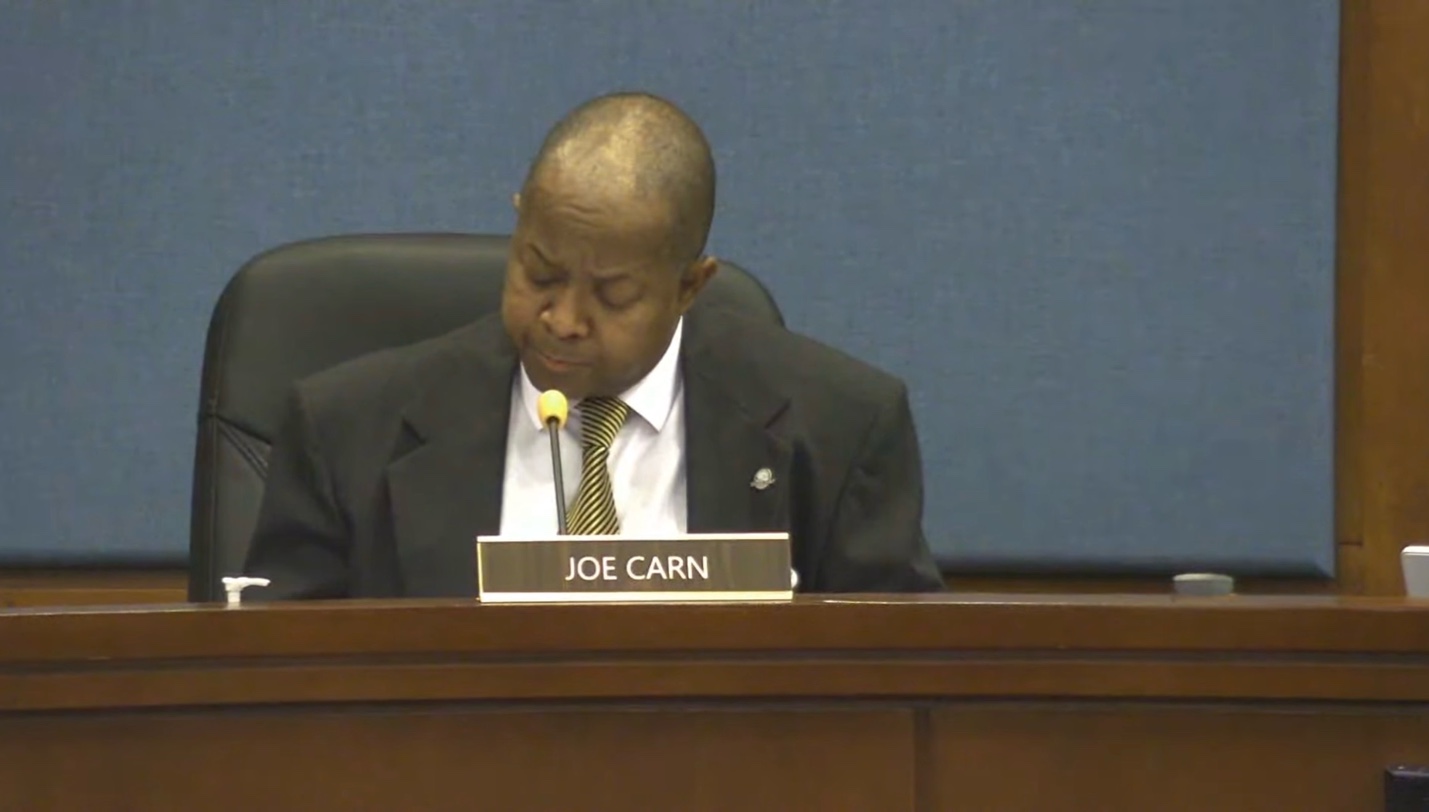
A councilman proposed new restrictions on how the Mayor can spend public funds — but not on himself.
The full Council approved it without a single question.
Should spending rules apply to one office, or all of them?
Resolution passed unanimously. Zero discussion. Not a single question raised.
Council members Joe Carn, Jamelle McKenzie, Tracie Arnold, and Roderick Gay all voted to approve new spending restrictions that target only the Mayor's office.
On March 2, 2026, College Park's City Council voted to approve Agenda Item 10A — a proposal by Mayor Pro Tem Joe Carn imposing new spending restrictions on the Mayor's use of community enhancement funds.
The resolution requires the Mayor — and only the Mayor — to get permission from a Council member before spending any amount, even though the City Manager currently has authority to approve expenditures under $10,000 for all elected officials equally.
No other Council member faces these restrictions. The measure passed with no discussion, no questions, and no debate. Council members Joe Carn, Jamelle McKenzie, Tracie Arnold, and Roderick Gay all voted yes.
Meanwhile, a review of publicly available records raises questions about how public funds are being spent — by the very officials who just voted to restrict someone else's.
Joe Carn's Agenda Item 10A proposes spending restrictions that apply only to the Mayor. Not to other Council members. Not to Joe Carn.
Public dollars. Questionable receipts.
Zero accountability.
The following are just a sample of the reimbursement records that raise questions. There are more. These aren't million-dollar scandals — they're small transactions, the kind that slip through when no one is watching.
The same event supply charges appear on both a city reimbursement request and a Campaign Contribution Disclosure Report (CCDR). If these were campaign expenses, they shouldn't have been reimbursed with public money. If they were city expenses, they shouldn't be on a campaign filing. Either way, these records appear to conflict.
A large number of gift cards purchased from Five Below using public funds. The only justification provided: "Community Enhancement/Community Engagement." No list of recipients. No event tied to it. No explanation of what public purpose was served. Gift cards are cash equivalents — this is the kind of purchase that demands airtight documentation. It got none.
A reimbursement was submitted for a purchase at a liquidation outlet with zero explanation of what was bought or why public funds were used. No item description. No stated purpose. Just a receipt and a request for money back. Public dollars require public accountability — this has neither.
Multiple reimbursements across restaurants, a tavern, home ink delivery, pizza, and a wholesale store — all from discretionary funds, all with minimal to no documentation of public purpose. One vague receipt might be an oversight. A pattern of them is something else entirely. The small things have a way of adding up.
Seven 64-gallon trash cans were purchased on the City's Home Depot commercial account — meaning the city already paid. The same items then appear in a separate reimbursement request to Joe Carn personally. If both were processed, the city allegedly paid twice and Joe Carn may have pocketed money he never spent.
During the March 2 meeting, Joe Carn addressed the questions raised about his spending — but only discussed one of the five flagged expenses: the Home Depot trash can purchase (Flag 05).
Carn called the Director of Finance to the podium. The city attributed it to a clerical error in the Finance office. The Director confirmed the money had been reimbursed.
No other flagged expenses — the campaign/city overlap, the bulk gift cards, the liquidation outlet purchase, or the restaurant pattern — were mentioned, discussed, or explained.
1 of 5 flags addressed.
What about the other four?
What Joe Carn's Agenda Item 10A would actually change — and who it targets
Under the current rules, the City Manager has authority to approve expenditures under $10,000 within the adopted budget. That authority applies equally to every elected official's community enhancement funds — Mayor, Mayor Pro Tem, and all Council members alike. Agenda Item 10A would strip that equal treatment by singling out the Mayor's office alone.
If spending oversight matters — and it does — it should apply to every member of the governing body, not just one. These are just a few of the flags found so far, and they all belong to the official proposing the new restrictions. We don't know the full scope of how these funds are being used across all offices. That's exactly the point — and that's exactly why equal scrutiny matters.
Independent Community Publication
This page is managed by concerned residents of College Park and is not affiliated with or sponsored by any elected official.